The December 29, 2022 probable cause affidavit is how the State of Idaho told a magistrate the story of Bryan Kohberger. It is short. It is confident. It is not a complete record of what investigators already knew.
Two pillars of that story have not aged well: the claim that the same car is on every camera, and the claim that surviving roommate Dylan Mortensen gave a stable, face-to-face identification that matched Kohberger’s driver’s license.
The paper people call “the PCA” — two different documents
What gets passed around as “the PCA” is often two filings stapled together:
- The affidavit — Cpl. Brett Payne’s sworn statement (Exhibit A). That is the story of the sheath, the Elantra, the phone, and D.M.
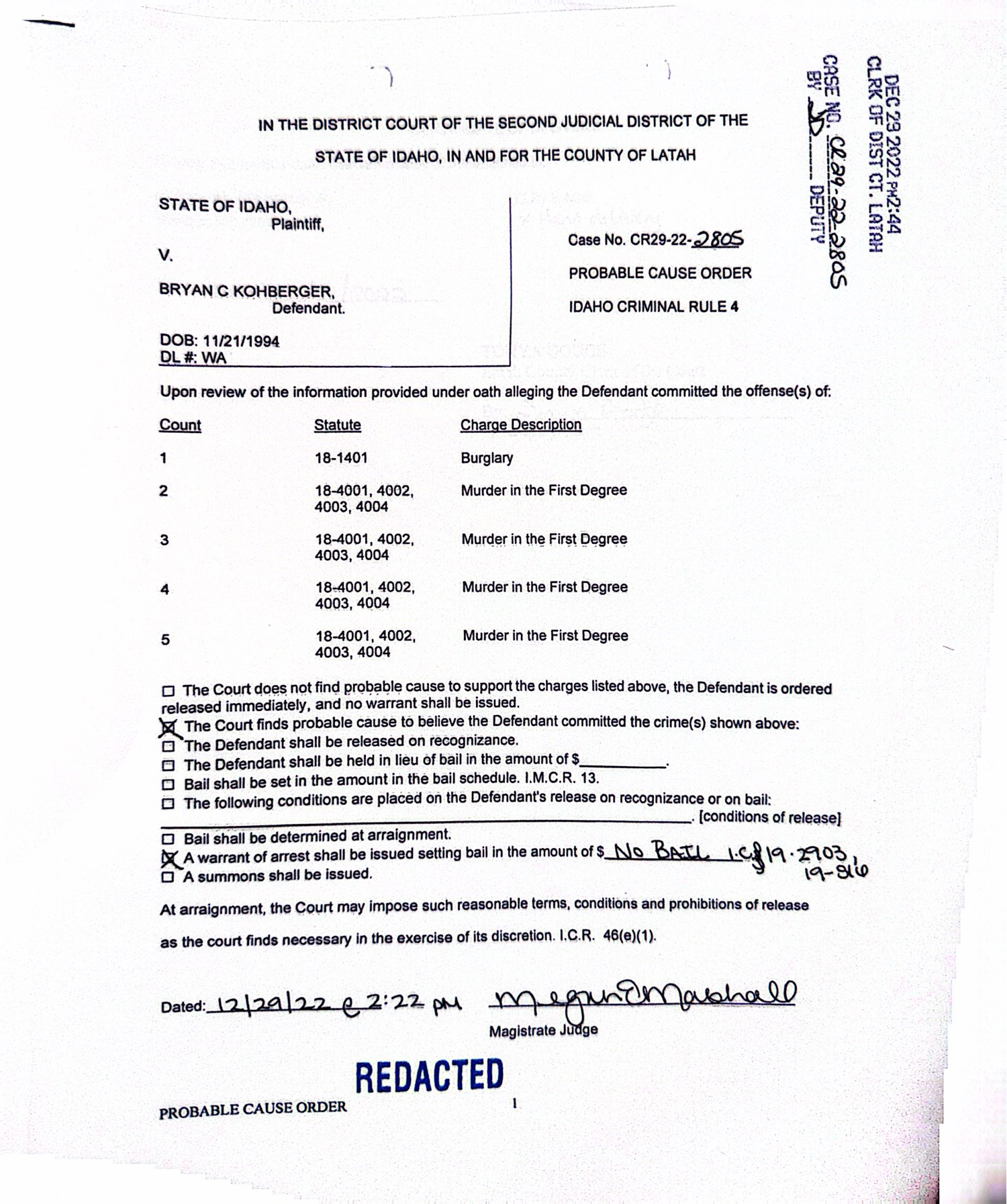
- The order — Magistrate Judge Megan E. Marshall’s one-page Rule 4 finding that probable cause exists, plus the clerk’s certificate of delivery. That is the scan below. It is not Payne’s narrative. It is the judge checking a box on the strength of that narrative.
File stamp, top right: Dec 29, 2022, 2:44 p.m., Clerk of Dist. Ct., Latah. Case CR29-22-2805. Caption: State of Idaho v. Bryan C. Kohberger, DOB 11/21/1994, WA driver’s license.
Charges on the face of the order:
- Count 1 — I.C. 18-1401 — Burglary
- Counts 2–5 — I.C. 18-4001, 4002, 4003, 4004 — Murder in the First Degree (four counts)
Boxes marked:
- The Court finds probable cause to believe the Defendant committed the crime(s) shown above.
- A warrant of arrest shall be issued setting bail in the amount of NO BAIL, handwritten cite I.C. § 19-2903, 19-816.
Dated in hand: 12/29/22, 2:22 p.m. Signed: Megan E. Marshall, Magistrate Judge. Stamped REDACTED at the foot of page 1.
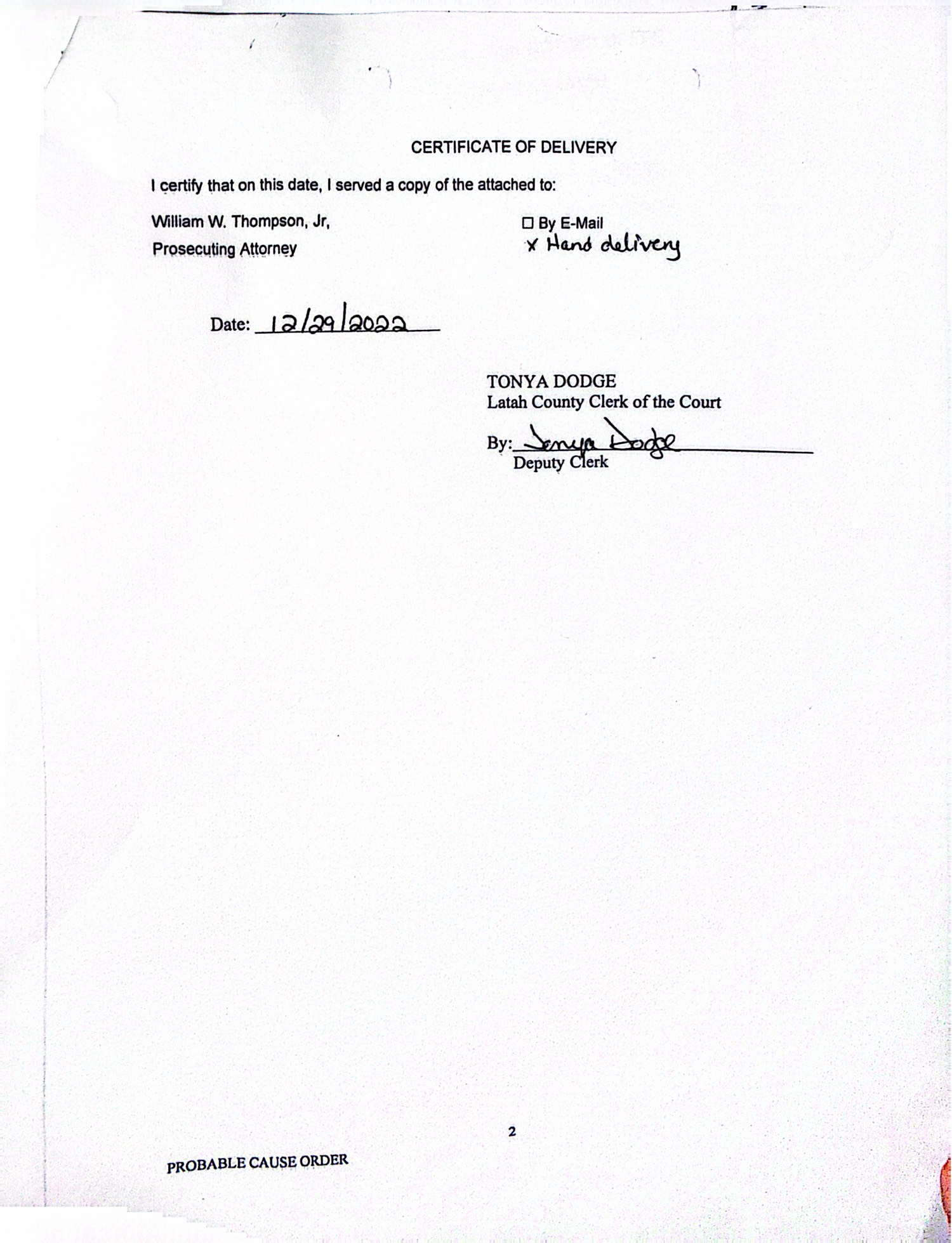
Page 2 is only the certificate of delivery. Deputy Clerk served a copy on Prosecuting Attorney William W. Thompson, Jr. by hand delivery on 12/29/2022. Signed Tonya Dodge for Latah County Clerk of the Court. Not emailed.
So the paper trail on this scan is: Payne’s affidavit goes to Marshall; Marshall finds PC at 2:22 p.m.; the clerk file-stamps at 2:44 p.m.; Thompson gets a hard copy the same day. That is proof the order issued. It is not proof that every sentence in Payne’s affidavit was true.
1. What the PCA actually said
Payne’s sworn statement boiled the case down to this:
- A tan Ka-Bar / USMC sheath on Madison Mogen’s bed with single-source male DNA on the snap.
- Trash from the Kohberger family home in Pennsylvania that “did not exclude” a man as the biological father of that profile.
- A white Hyundai Elantra — first called a 2011–2013, then stretched toward 2016 — circling King Road and leaving at a high rate of speed around 4:20 a.m.
- WSU / Pullman cameras of “a similar vehicle” leaving town before 3:00 a.m. and coming back around 5:30 a.m.
- D.M. seeing a masked man in black, 5'10" or taller, athletic, bushy eyebrows, walking toward her, then out the sliding door.
- Kohberger’s license photo “consistent” with that description because he has bushy eyebrows.
That last sentence is the tell. The affidavit does not say Dylan identified Bryan Kohberger. It says Payne looked at a DMV photo and decided the eyebrows matched.
2. The Pullman camera they could not keep
The PCA treats Pullman and Moscow as one car on one route: east out of Pullman before 3:00 a.m., loops on King Road, gone at 4:20, back on Pullman cameras near 5:30.
That only works if every white sedan in those frames is the same vehicle. They are not.
A white Elantra on WSU / Stadium Way cameras around 2:44–2:53 a.m. shows illuminated fog lights. Bryan Kohberger’s 2015 Elantra, as seized and photographed, has black plastic covers / blank-offs in the fog-lamp openings. It does not show working fog lamps in the later, clearer clips — Floyd’s Cannabis at about 3:02 a.m., the return into Pullman around 5:25–5:28 a.m., or the Clarkston shopping video the same afternoon.
Independent frame-by-frame work, and later commentary around the case, treated the 2:44/2:53 fog-light car as a different Elantra. You cannot run fog lamps at 2:53 and have empty black covers at 5:26 unless you changed the front of the car in two hours. Nobody produced that explanation.
What that means for the PCA:
- The affidavit used WSU “leaving town” footage as if it were Kohberger departing for Moscow.
- Once the fog lights are visible, that clip stops being his car.
- The State still had other cameras. They did not have a clean, unbroken film of his Elantra from apartment to King Road.
- Payne never told the magistrate: one of the Pullman cars we cited has fog lights; the car we seized does not.
3. What Dylan said — in order — not what the PCA sold
Dylan Mortensen is a surviving roommate. She was 19 — she had just had a birthday — intoxicated, terrified, and standing in a dark hallway. None of that is her fault. The problem is what police wrote on top of her.
The PCA reads like she gave one description, once, that locked onto Kohberger. Her interviews do not read that way.
First hours: no eyebrows, no ID
On body camera and in the first sit-down, she described a person in all black with a mask covering forehead and mouth. Height: about 5'10" or a little taller — her height. Build: not bulky; skinny/toned, “like a basketball player.” He looked at her. He did not come at her. He went toward the side / sliding door.
When asked about eyes and eyebrows that first day:
She did not know the color of the intruder’s eyes or eyebrows. Everything was “kind of blurry.” She said she saw his eyes and he saw her — and in the same breath that she did not remember what his eyes looked like. Defense Motion in Limine #7 summary of the early Mowery / first-day interviews; body-cam and first recorded interview
Judge Hippler later admitted the obvious part in writing: “she did not mention his eyebrows in her initial interview.”
Days later: “bushy” appears
By November 17 and December 1, the phrase is in the record. Even then she hedges it:
“I just remember eyebrows. I don’t know exactly what his eyebrows look like at all really. I just remember thinking like eyebrows… Yeah, bushy. But that’s all — I don’t remember the shape. I don’t remember the color.” Dylan Mortensen interview with Det. Victoria Gooch / Sgt. Dustin Blaker, Nov. 17, 2022
December 1: she did not see his eyes; she saw “one eyebrow or two, but it was just, like, this bushy eyebrow.”
That is a fragment behind a mask. It is not a lineup. It is not eye color, hairline, face shape, or a man she could pick out of a photograph.
After the mugshot: she did not recognize him
Kohberger was arrested December 30, 2022. Dylan found a mugshot online. Detectives Lake and Tolleson asked if that was the man in the house.
She did not know if Bryan Kohberger was the intruder. After seeing the picture: “Nothing came back to me at all. I feel like if I saw that my mind would be like, ‘Oh yeah, that’s him, but … I just don’t remember at all.’” And: “From people releasing Bryan Kohberger’s name, I know it’s him, but I don’t know.” Dec. 30, 2022 Lake interview, as quoted in Motion in Limine #7 and later reporting on the unsealed transcript
All she still had was “some bushy eyebrow and all black and some sort of mask.”
If this were a true face-to-face identification, the mugshot is the moment it should lock. It did not lock. Police had already written the PCA around the eyebrows anyway.
4. “Face to face” is the media line, not the geometry
Headlines said she came face to face with the killer. The PCA said the figure was “walking towards her” and she stood in a “frozen shock phase.”
Her own account is thinner than that:
- She opened her door more than once. She did not stand in the hall having a conversation.
- He walked past. He did not speak to her. He did not stop.
- A ski-style mask covered forehead and lower face. She later said she did not remember the nose and did not remember the eyes.
- The hallway was dark. She said her vision was blurry. She thought he might be holding a mini-vacuum, then a bulge at the waist, maybe a gun.
- She locked the door and did not call 911 for hours.
A masked stranger passing a bedroom doorway in the dark is not a face-to-face ID. It is a glimpse. Payne turned the glimpse into “bushy eyebrows + 6-foot criminology student = same man.”
5. Side by side
| PCA / press version | What is actually in the interviews and video |
|---|---|
| One white Elantra from Pullman to King Road and back | WSU 2:44–2:53 car shows fog lights; Kohberger’s seized car has blank covers; that early Pullman clip does not survive as his |
| 2011–2013 Elantra | His car is a 2015; FBI year range was later expanded |
| D.M. described bushy eyebrows (presented as the first description) | Not in the first interview; Hippler conceded that; “bushy” arrives in later sittings, still with “I don’t remember shape or color” |
| Physical description matches Kohberger’s license | 5'10" or a bit taller, basketball-player thin, all black, mask — generic. Payne matched the photo. Dylan did not |
| Face-to-face encounter with the killer | Door cracked, masked figure walked past, no words to her, blurry, she could not ID the mugshot |
| She would know him if she saw him | Dec. 30: nothing came back; she knew the name from the news, not from the hallway |
6. Why this matters
Probable cause is a low bar. A judge can sign an arrest warrant on less than this. That is not the same as the affidavit being honest.
The PCA did three things that still need to be said out loud:
- It stitched multiple white cars into one car, including a Pullman clip that fog lights knock out.
- It put “bushy eyebrows” in Dylan’s mouth as if that were the first, firm, identifying feature. It was not first, and she never made it an identification.
- It let Payne do the identification from a driver’s license after they already had a name — then sold the public a survivor who had locked eyes with Bryan Kohberger. She said she had not.
Dylan’s trauma is real. Using a traumatized witness’s later, narrower memory as if it were a courtroom ID — while she is looking at a mugshot and saying she does not recognize him — is how charging documents get written. It is not how they should be read.